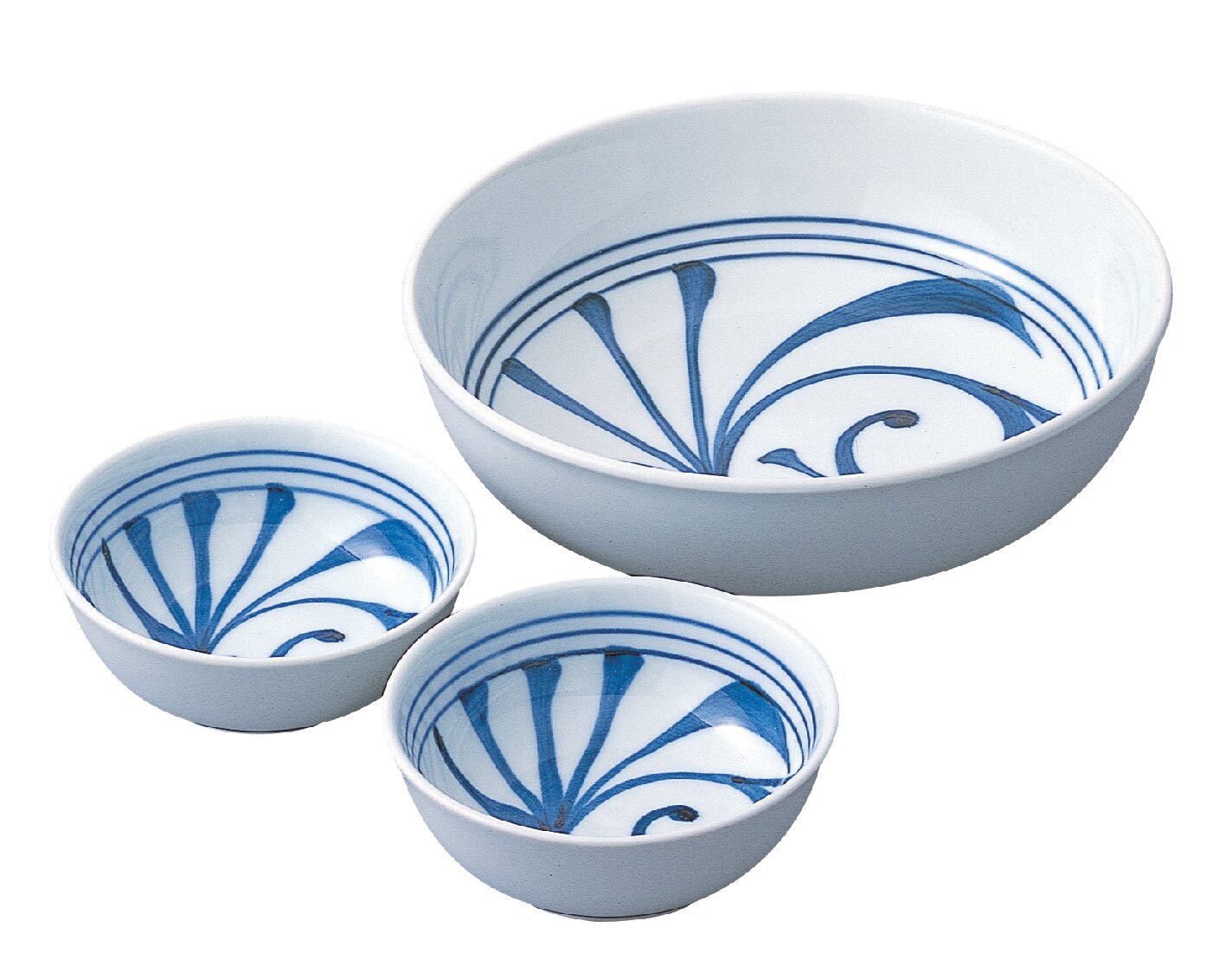
<Tobe ware> Gosu arabesque flat bowl and small bowl set
Couldn't load pickup availability
<Baizangama> Tobe-yaki Gosu Karakusa Flat Bowl and Small Bowl Set. 1 flat bowl, 2 small bowls. Flat bowl: approx. height 6.5 x diameter 22 cm, small bowl: approx. height 4 x diameter 11.7 cm. Porcelain. Made in Japan. *Microwave safe. As this is a handmade product, the color, pattern and size may vary. The delicate yet bold beauty conveyed by the blue painted bowls from Ehime Prefecture. Bold painting on thick, plump white porcelain. Tobe-yaki is a simple, durable and easy-to-use everyday dish with warm white porcelain and blue patterns made from gosu.
Tobe pottery has a long history, with pottery needed for daily life being made there for over 300 years. This area, which was once the territory of the Ozu Domain, was a producer of whetstones. The lord of the Ozu Domain noticed the shavings that were produced when whetstones were cut, and ordered the production of porcelain to begin. After several years of trial and error, the foundations of today's Tobe ware were finally completed. Porcelain is fired at a higher temperature than pottery, making it hard and durable. It was suitable for practical items in daily life.
During the Mingei movement that emerged after the war, art critic and thinker Muneyoshi Yanagi and ceramicist Kenkichi Tomimoto took notice of Tobe ware. They discovered the "beauty of utility" in the handmade everyday items that were used in daily life.
Founded in 1881 by Umeno Masagoro, Umeyama Kiln is the largest kiln in Tobe, Ehime Prefecture. With around 50 craftsmen, the kiln currently produces 6,000 to 7,000 types of porcelain. They faithfully and carefully preserve the traditions of shapes that are close to daily life, patterns that evoke nature, and simple, beautiful handicrafts. Enjoy the patterns drawn in a single stroke There are four methods for shaping pottery that is hard to break and easy to use. The first is "hand-building," in which a potter's wheel is turned by hand to create a shape from a lump of clay. The second is a method in which a mechanical potter's wheel is used to put clay into a mold. The third is "casting," in which liquid clay is poured into a mold. The last method is "tatara," in which clay is placed on top of a mold, covered with a cloth, and then hammered.
Once dried and removed from the mold, the ware is bisque fired at approximately 950°C and painted by hand. This painting is the greatest feature of Tobe ware. All of the original patterns, such as arabesque, sun, shepherd's purse, red-lined trefoil, and red chrysanthemums with cobalt blue, are based on natural motifs. These simple yet profound patterns are painted one by one using a brush soaked in cobalt blue in the "Baizan style" technique, allowing you to enjoy each and every expression. When the ware is glazed and fired in a kiln at 1300°C, the blue color of the cobalt blue stands out against the smooth white porcelain, creating a refreshing appearance.
While many pottery production areas have moved towards mechanization, Tobe has completely missed the wave of modernization. However, this has led to the tradition of handicraft being passed down, which is the unique charm of Tobe ware.
*Items will be shipped within 5 days to 1 week of purchase.